Table of Content
HMI and SCADA Systems: Differences, Functions and How They Work with PLCs

Written by
Artur Solakhyan
Freelance copywriter and editor
Published at19 November 2026
Estimated reading time3 min read
Share This:
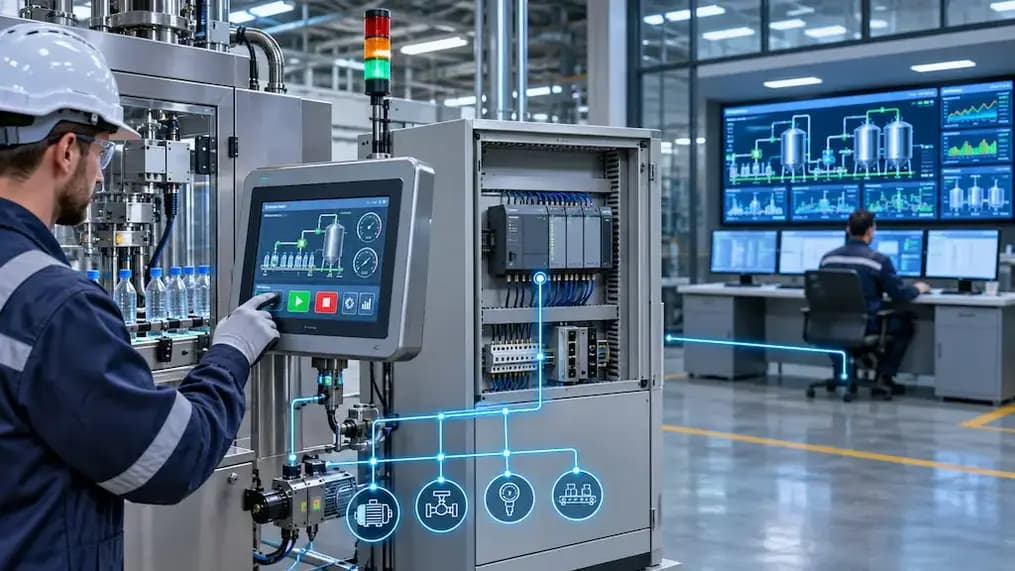
HMI and SCADA are two essential technologies in industrial automation, but they serve different roles. An HMI gives operators a local interface for monitoring and controlling machines, while SCADA provides centralized supervision, data collection, alarm management and reporting across larger systems. PLCs form the control layer underneath both, executing the logic that operates motors, valves, actuators and other equipment. Understanding how HMI SCADA and PLC systems interact helps engineers design automation architectures that are easier to operate, monitor, maintain and expand.
What Is an HMI System?
A Human-Machine Interface, or HMI, is a visual interface that allows operators to interact with industrial equipment and processes. It displays machine status, process values, alarms, controls and operating parameters in a format that users can understand quickly.
Modern HMI systems range from compact panel displays to industrial computers and software interfaces. For a brand-specific example, see the Allen-Bradley HMI guide.
Main Functions of an HMI System
An HMI typically supports:
- Equipment monitoring
- Process visualization
- Operator commands
- Setpoint and parameter changes
- Alarm notifications
- Machine status indication
The HMI does not usually execute the core machine-control logic. Instead, it displays and exchanges information with PLCs and other controllers.
Common Types of HMI Systems
Common HMI formats include panel-mounted operator terminals, industrial PC-based interfaces and software-based visualization systems.
Panel HMIs are common on individual machines. Industrial PCs support more complex interfaces, while software HMIs can run on larger workstations.
Products such as SEW-EURODRIVE HMI Modules and Allen-Bradley human machine interfaces illustrate the range available for industrial applications.
Key Components of an HMI System
Typical HMI systems include:
- Operator display
- Touchscreen or physical input controls
- Communication interfaces
- HMI software
- Network connection to a PLC or controller
The exact architecture depends on the machine and communication requirements.
What Is a SCADA System?
SCADA stands for Supervisory Control and Data Acquisition. A SCADA system provides centralized monitoring and supervisory control across machines, production lines, facilities, or distributed industrial assets.
Unlike a local HMI, SCADA commonly collects data from multiple PLCs, RTUs, sensors and control devices.
Main Functions of a SCADA System
SCADA platforms commonly provide:
- Real-time monitoring
- Data acquisition
- Supervisory control
- Alarm management
- Historical data logging
- Reporting
- Trend analysis
This broader scope makes SCADA particularly useful for operations that require centralized visibility.
Key Components of a SCADA System
A typical SCADA architecture may include:
- SCADA servers
- Operator workstations
- PLCs
- Remote terminal units
- Communication networks
- Data historians
- Field devices
These components work together to collect, process, display and store operational information.
How Does a SCADA System Work?
Field devices measure process conditions and send information to PLCs or RTUs. The SCADA platform collects this data through the communication network and presents it to operators.
Supervisors can review alarms, trends, equipment conditions and production information from a central interface. Authorized commands or setpoint changes can also be sent back through the control architecture.
How Do HMI and SCADA Work with PLCs?
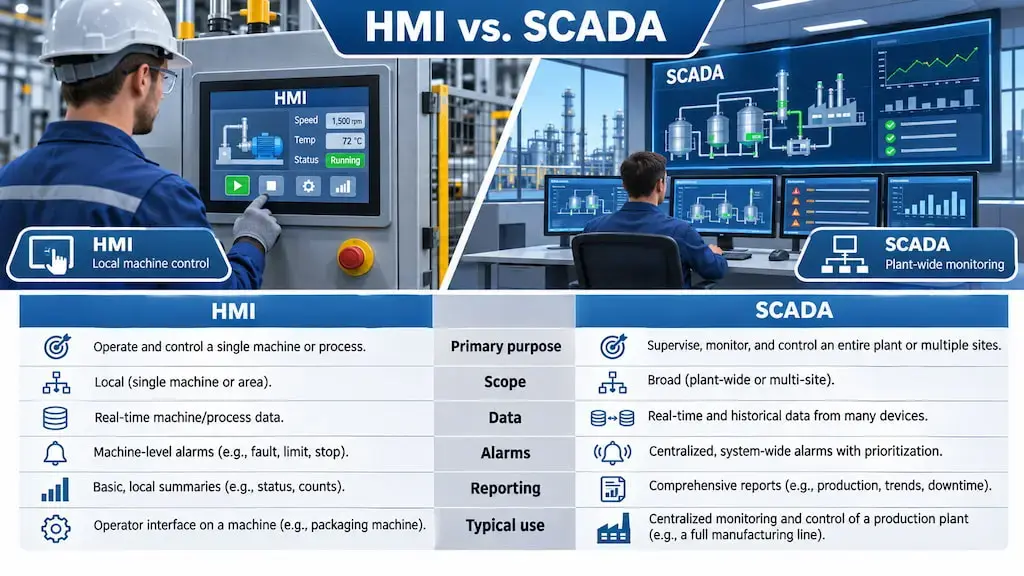
An HMI SCADA PLC architecture combines three layers: control, visualization and supervision.
The Role of PLCs in Industrial Automation
PLCs receive signals from sensors and other field devices, execute programmed logic and control equipment such as motors, drives, valves, cylinders and actuators.
For legacy and compact platforms, see our guide to Microlofix PLCs.
PLCs remain responsible for local control even when HMI or SCADA systems are connected.
How Data Flows Between PLCs, HMIs and SCADA Systems
A typical sequence looks like this:
- Sensors and field devices collect process information.
- PLCs receive signals and execute control logic.
- HMIs retrieve PLC data for local operators.
- SCADA collects information from multiple PLCs and devices.
- Operators and supervisors monitor conditions and send authorized commands.
A simplified architecture is:
Field Devices → PLCs → HMI / SCADA → Operators and Supervisory Monitoring
The exact command and data paths depend on the system design.
Communication Protocols Used in HMI and SCADA Integration
Industrial protocols allow PLCs, HMIs and SCADA platforms to exchange information.
Common examples include:
- Modbus RTU
- Modbus TCP
- OPC UA
- PROFINET
- EtherNet/IP
These protocols support different network architectures and integration requirements. The Allen-Bradley PLC communication protocols and types guide provides more detail on controller communication.
Key Industrial Applications of HMI and SCADA Systems
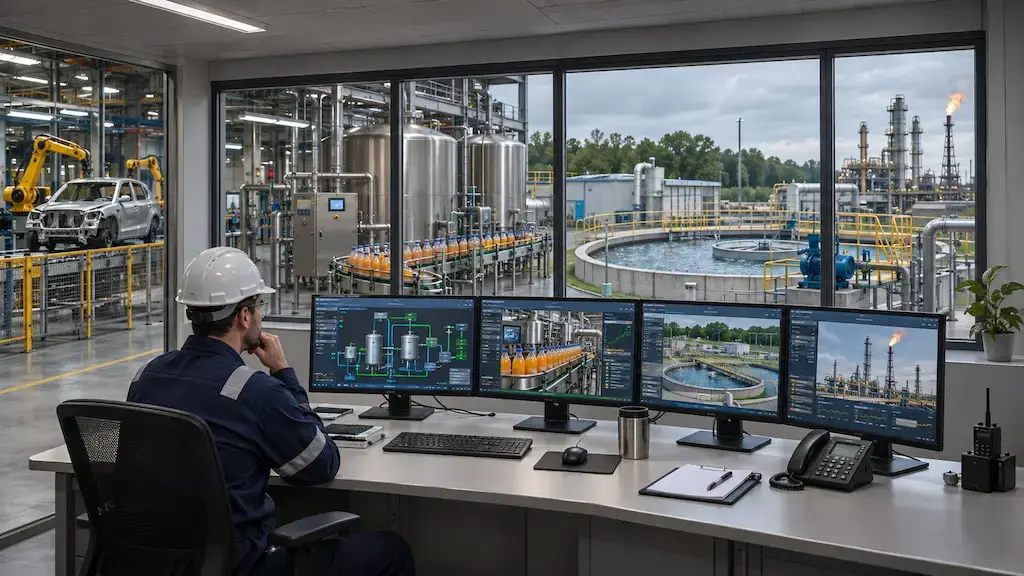
HMI and SCADA technologies appear across many industries.
In manufacturing, HMIs let operators control individual machines while SCADA provides plant-wide production monitoring.
Water and wastewater facilities use local interfaces at equipment stations and SCADA for pumps, tanks, treatment processes and distributed assets.
Oil and gas operations rely on centralized monitoring of pressure, flow, equipment status and remote installations.
Power generation and distribution systems use SCADA for supervisory control across electrical infrastructure.
Food and beverage plants use HMIs for machine operation and SCADA for production data, alarms, process supervision and reporting.
The same systems may integrate with Allen-Bradley drives, PLCs, sensors and other equipment from global industrial automation brands.
When Do You Need an HMI, SCADA, or Both?
A standalone HMI is usually sufficient when operators only need to monitor and control one machine or a small local process.
SCADA becomes more useful when a facility requires:
- Multiple PLC connections
- Centralized supervision
- Historical data
- Plant-wide alarms
- Reporting
- Remote monitoring
- Larger system expansion
Using both makes sense when operators require local machine control while supervisors need centralized visibility across the entire production environment.
Key considerations include equipment scale, controller count, communication requirements, data retention, alarm management, reliability and future expansion.
Companies maintaining existing systems may also need replacement AB parts or guidance on buying Allen-Bradley PLC parts. An industrial automation parts supplier can help source components for both current and legacy systems.
FAQ
HMI stands for Human-Machine Interface. It allows operators to monitor equipment, view process information, adjust parameters and send commands.
SCADA stands for Supervisory Control and Data Acquisition. It provides centralized monitoring, data collection, alarm management and supervisory control.
It can be. SCADA platforms commonly include operator interfaces that perform HMI-like functions, although standalone HMIs also exist independently.
Yes, depending on the architecture. SCADA can communicate with RTUs, intelligent devices and other controllers, although PLCs are common in industrial installations.
A PLC executes control logic. An HMI provides local operator interaction. SCADA provides broader monitoring, data acquisition, historical storage and supervisory control.
No. Small machines may only require an HMI, while larger facilities may need SCADA or both. The correct choice depends on system size, monitoring needs, data requirements and architecture.
For additional definitions, see BSP Automation's automation terminology and guide to top PLC brands.


Have a question?
If you didn't find the automation part you were looking for, our support team is here to help. Just contact us, and we'll do our best to source the exact part you need. We're committed to meeting your needs and ensuring your satisfaction.
Contact Us Now