Table of Content
Inductive vs Capacitive Sensors: Key Differences and Applications

Written by
Artur Solakhyan
Freelance copywriter and editor
Published at28 August 2026
Estimated reading time3 min read
Share This:
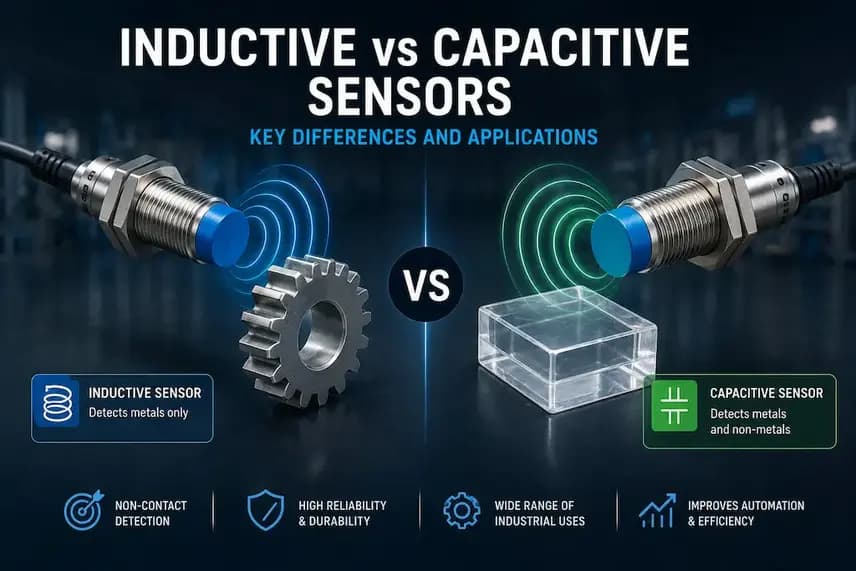
Inductive and capacitive sensors are two common proximity sensor technologies used for non-contact object detection in industrial automation. Although both identify nearby targets without physical contact, their operating principles and suitable materials differ significantly. Inductive sensors primarily detect metals, while capacitive sensors can detect both conductive and non-conductive materials. Understanding these differences helps engineers select the appropriate technology for reliable detection, process monitoring and machine control. This guide compares inductive and capacitive sensors and explains their applications, strengths, limitations and selection criteria.
What Are Inductive Sensors?
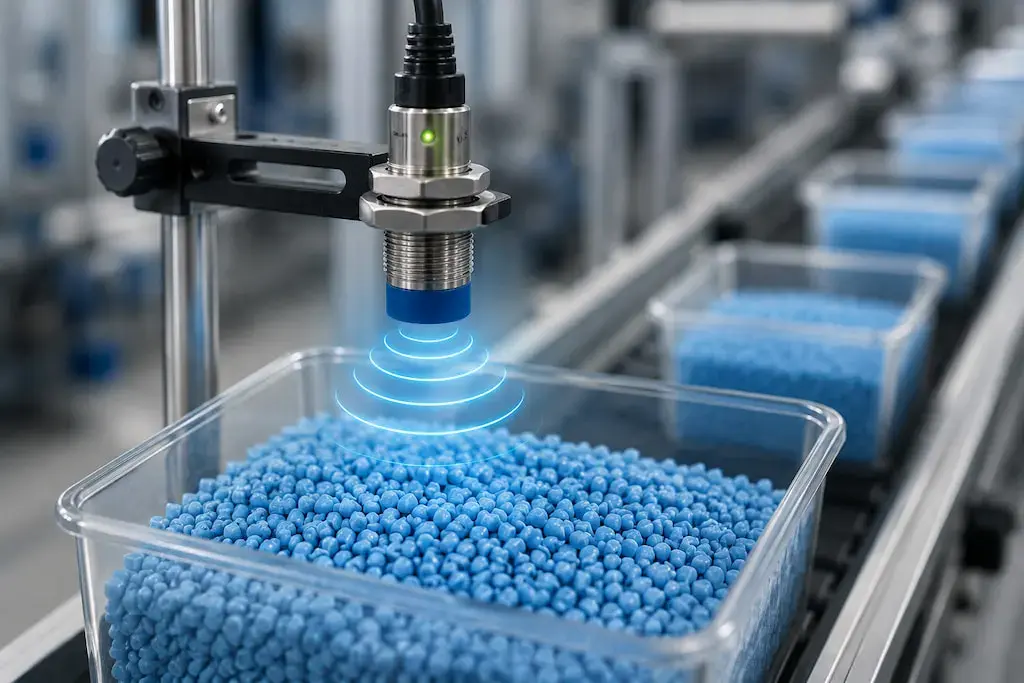
Inductive sensors detect conductive targets using an electromagnetic field. They are widely used in industrial equipment because they provide reliable, contactless metal detection under demanding operating conditions.
How inductive sensors work
A coil generates an electromagnetic field near the sensing face. When metal enters this field, eddy currents alter the oscillator behavior, allowing the sensor to detect the target.
What materials can inductive sensors detect?
They primarily detect metals such as steel, iron, aluminum, brass and copper. Detection distance can vary according to the target material.
Key advantages of inductive sensors
Inductive sensors provide fast response, good repeatability and resistance to many industrial contaminants. Their contactless operation also reduces mechanical wear.
Common limitations of inductive sensors
Their main limitation is material compatibility. They cannot directly detect most plastics, glass, liquids, powders, or other non-conductive materials.
What Are Capacitive Sensors?
Capacitive sensors detect changes in capacitance caused by objects entering their sensing field. Unlike inductive sensors, they can detect conductive and non-conductive materials.
How capacitive sensors work
The sensing face creates an electrostatic field. A nearby target changes the capacitance and the sensor switches when this change reaches a configured threshold.
What materials can capacitive sensors detect?
They can detect metal, plastic, glass, wood, liquids, powders and granular materials. Proximity - Capacitive by IFM products illustrate this broader sensing capability.
Key advantages of capacitive sensors
Their primary advantage is material versatility. They can also detect substances through certain non-metallic container walls, making them useful for level monitoring.
Common limitations of capacitive sensors
Humidity, dust buildup, temperature changes and nearby materials can affect detection. Proper sensitivity adjustment is therefore important.
Inductive vs Capacitive Sensors: What Is the Difference?
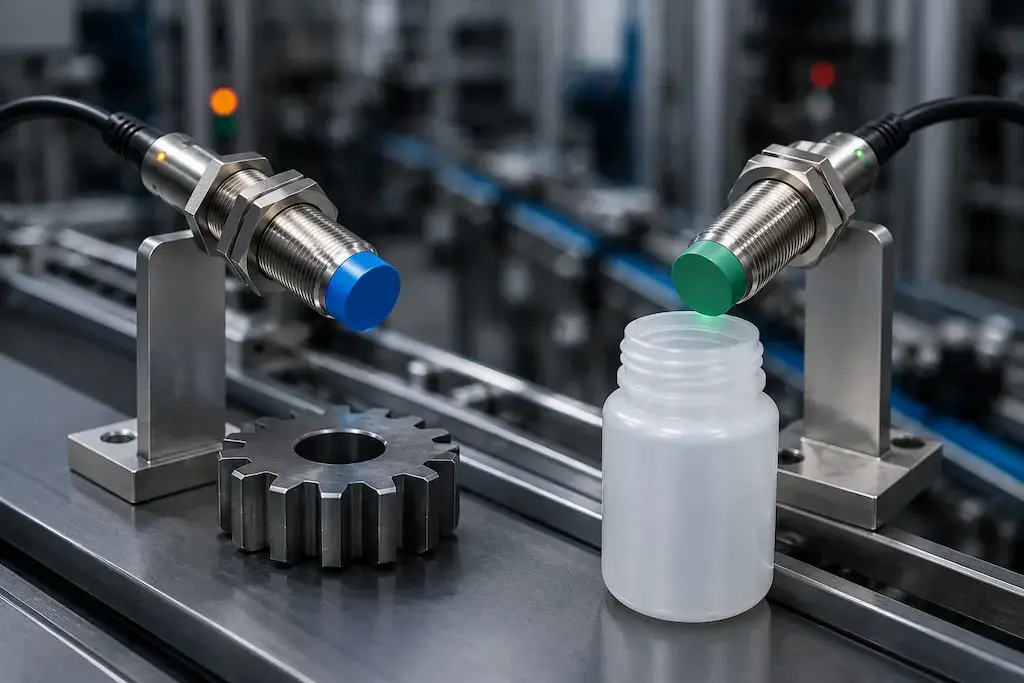
The difference between inductive and capacitive proximity sensors extends beyond the materials they detect.
Detection principle
Inductive sensors use electromagnetic fields. Capacitive sensors respond to changes in an electrostatic field.
Detectable materials
Inductive models specialize in conductive metal targets. Capacitive sensors detect a considerably broader range of materials.
Sensing range
Both technologies are typically used for relatively short-range detection, although actual distance depends on sensor design and target characteristics.
Sensitivity to environmental conditions
Inductive sensors are generally less sensitive to dust, humidity and material buildup. Capacitive sensors require greater consideration of surrounding conditions.
Accuracy and reliability
Both can provide dependable detection when correctly selected. Inductive sensing is particularly consistent for metal targets, while capacitive performance depends more strongly on target properties and calibration.
Typical installation and adjustment requirements
Inductive sensors are often straightforward to install for metal detection. Capacitive sensors may require sensitivity adjustment to distinguish the intended target from surrounding materials.
Inductive vs Capacitive Proximity Sensors: Which Should You Choose?
The inductive vs capacitive proximity sensors decision should begin with the target material and operating environment.
Choose inductive sensors for metal detection
Use inductive sensing for dependable detection of metal parts, tools, machine components and workpieces.
Choose capacitive sensors for non-metallic materials
Capacitive technology is preferable for plastics, glass, powders, liquids and other non-metallic targets.
When capacitive sensing is useful for level detection
Capacitive sensors can monitor liquids or bulk materials inside suitable non-metallic containers without direct contact with the substance.
When environmental conditions affect sensor selection
Where contamination, humidity, or material buildup is significant, evaluate whether these factors could cause false capacitive readings.
Applications of Inductive Sensors
Position and presence detection
Inductive sensors verify the position of metallic machine components.
Metal part detection
They confirm whether metal workpieces are present before processing begins.
Counting and sorting metal components
Sensors can count parts moving through automated production equipment.
Machine automation and control systems
They provide feedback to PLC-based machinery, including systems using Allen-Bradley controllers.
Conveyor and manufacturing applications
Inductive detection is common in conveyors and metal manufacturing equipment.
Applications of Capacitive Sensors
Liquid level detection
Capacitive sensors can detect liquid through compatible container walls.
Powder and granular material detection
They are used for powders, pellets, grains and similar bulk materials.
Plastic and glass detection
Their ability to detect non-metallic targets makes them suitable for plastic and glass products.
Packaging and material handling
Capacitive sensors identify products and packaging materials that inductive technology cannot detect.
Presence and fill-level monitoring
They can verify container contents and monitor material levels during production.
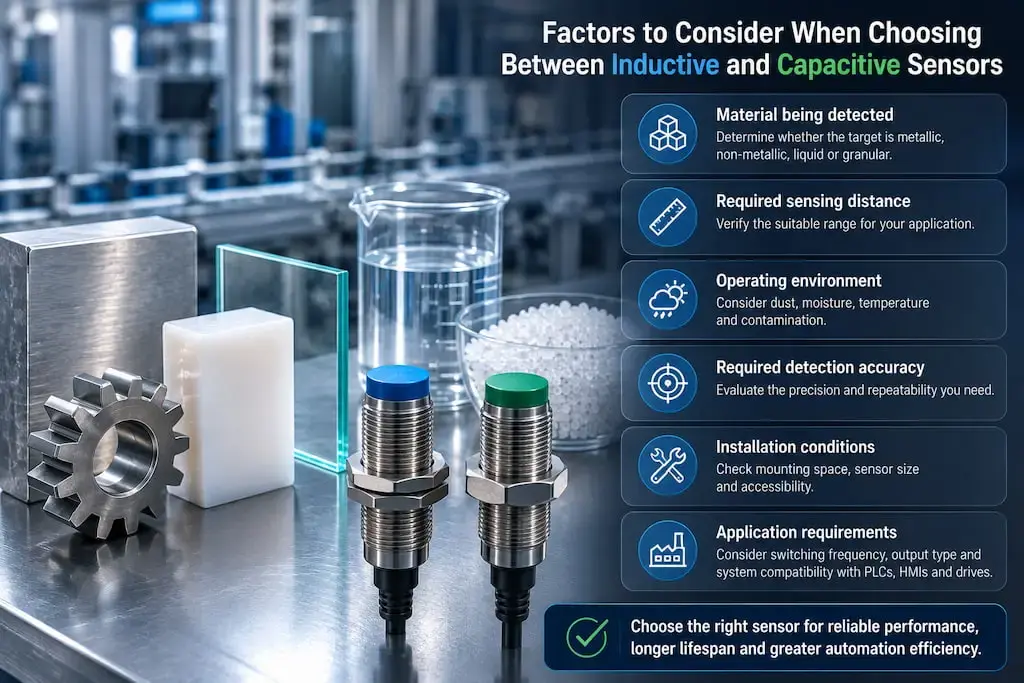
Factors to Consider When Choosing Between Inductive and Capacitive Sensors
Material being detected
Determine whether the target is metallic, non-metallic, liquid, or granular.
Required sensing distance
Verify the manufacturer's specified operating range for the actual target material.
Operating environment
Consider dust, moisture, temperature, vibration and contamination.
Required detection accuracy
Evaluate repeatability and the precision required by the process.
Installation conditions
Check available mounting space, nearby materials and sensor positioning.
Application requirements
Consider switching frequency, electrical output, PLC compatibility and maintenance requirements. Suppliers and products such as Siemens sensors, Danfoss sensors and SEW-EURODRIVE provide sensing solutions for different industrial requirements.
Find the Right Proximity Sensor for Your Application
Selecting the correct proximity sensor requires evaluating target material, sensing distance, environment, mounting and control-system compatibility. BSP Automation supplies sensors and related components from established industrial manufacturers, helping businesses source suitable equipment for new and existing automation systems.
FAQ
Inductive sensors primarily detect metal, while capacitive sensors detect both conductive and non-conductive materials.
It detects conductive metals such as steel, iron, aluminum, brass and copper.
It can detect metals, plastics, glass, liquids, powders, wood and granular materials.
Neither is universally better. Inductive sensors are preferable for reliable metal detection, while capacitive sensors offer greater material versatility.
Yes. Capacitive sensors can detect metal as well as many non-metallic materials.
Capacitive sensors are generally more suitable because they can detect liquids and may sense them through non-metallic container walls.
Choose according to target material, required sensing distance, environmental conditions, installation constraints and electrical compatibility.



Have a question?
If you didn't find the automation part you were looking for, our support team is here to help. Just contact us, and we'll do our best to source the exact part you need. We're committed to meeting your needs and ensuring your satisfaction.
Contact Us Now