Table of Content
Photoelectric Sensor Types: How to Choose the Right One for Your Application

Written by
Artur Solakhyan
Freelance copywriter and editor
Published at25 August 2026
Estimated reading time4 min read
Share This:
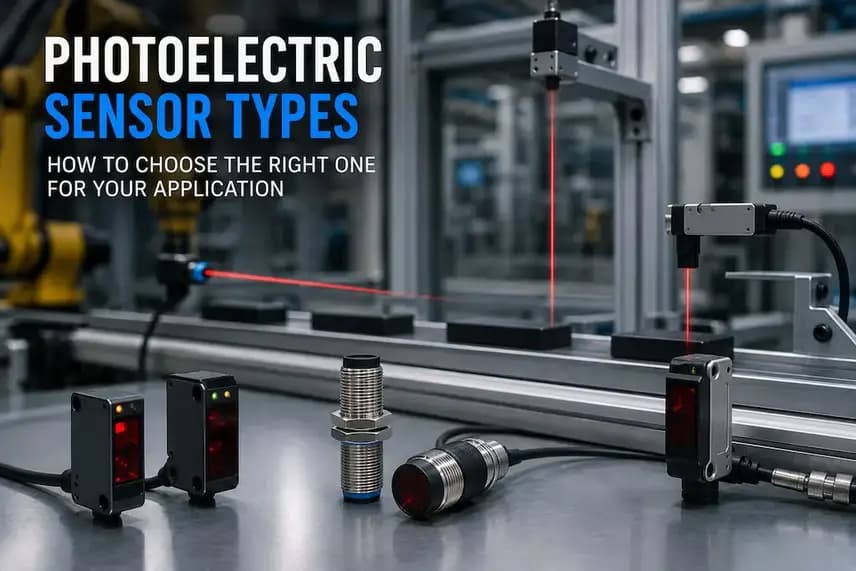
Understanding photoelectric sensor types is essential when designing reliable object detection and machine control systems. Different sensors use different light-based detection principles, which affect sensing distance, accuracy, installation and suitability for specific targets. Through-beam, retro-reflective, diffuse-reflective and background suppression sensors each address different industrial requirements. This guide explains how these technologies work, compares their strengths, covers common applications and provides practical selection criteria based on sensing distance, target properties, environmental conditions and electrical requirements.
What Is a Photoelectric Sensor?
A photoelectric sensor detects objects without physical contact by transmitting light and monitoring how that light reaches a receiver. These sensors are common in manufacturing, packaging, conveyors, assembly equipment and other automated machinery.
How Photoelectric Sensors Work
An emitter generates visible or infrared light. The sensor identifies an object when that light beam is interrupted, reflected, or changed according to the sensing method.
Key Components of a Photoelectric Sensor
Typical components include an emitter, receiver, optical system, signal-processing electronics and output circuit connected to a PLC or controller.
Photoelectric vs. Proximity Sensors
Photoelectric sensors use light and can provide greater sensing distances. Conventional inductive or capacitive proximity sensors detect targets through electromagnetic or capacitive principles at shorter distances.
Main Photoelectric Sensor Types
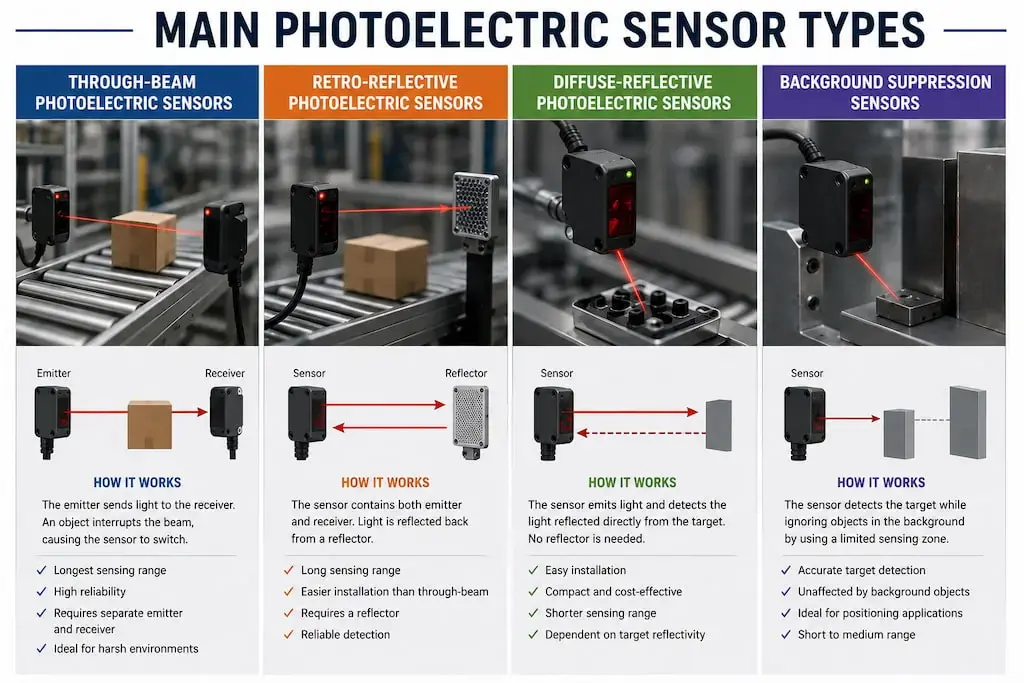
The main types of photoelectric sensor differ primarily in the location of the emitter and receiver and how light returns to the sensing device.
Through-Beam Photoelectric Sensors
Through-beam systems use separate emitters and receivers positioned opposite each other. An object is detected when it interrupts the beam. They provide long sensing distances and dependable detection.
Retro-Reflective Photoelectric Sensors
The emitter and receiver share one housing while a reflector returns the beam. Products such as Allen-Bradley sensor reflectors support this configuration.
Diffuse-Reflective Photoelectric Sensors
Diffuse sensors emit light toward the target and detect light reflected directly from its surface. No separate receiver or reflector is required.
Background Suppression Sensors
These sensors distinguish the intended target from objects behind it based largely on distance, improving detection where background reflections could cause errors.
How the Different Types of Photoelectric Sensors Compare
Selection depends on more than maximum sensing distance.
Through-Beam vs. Retro-Reflective Sensors
Through-beam sensors generally provide longer range and strong reliability, but require wiring and alignment on both sides. Retro-reflective models simplify installation by using one powered sensor and a reflector.
Retro-Reflective vs. Diffuse Sensors
Retro-reflective sensors provide predictable detection using a reflector. Diffuse sensors require fewer components but performance can vary with target color and reflectivity.
Diffuse vs. Background Suppression Sensors
Standard diffuse sensing depends more heavily on reflected light intensity. Background suppression provides better target discrimination where objects appear against nearby surfaces.
Photoelectric Sensor Types and Applications
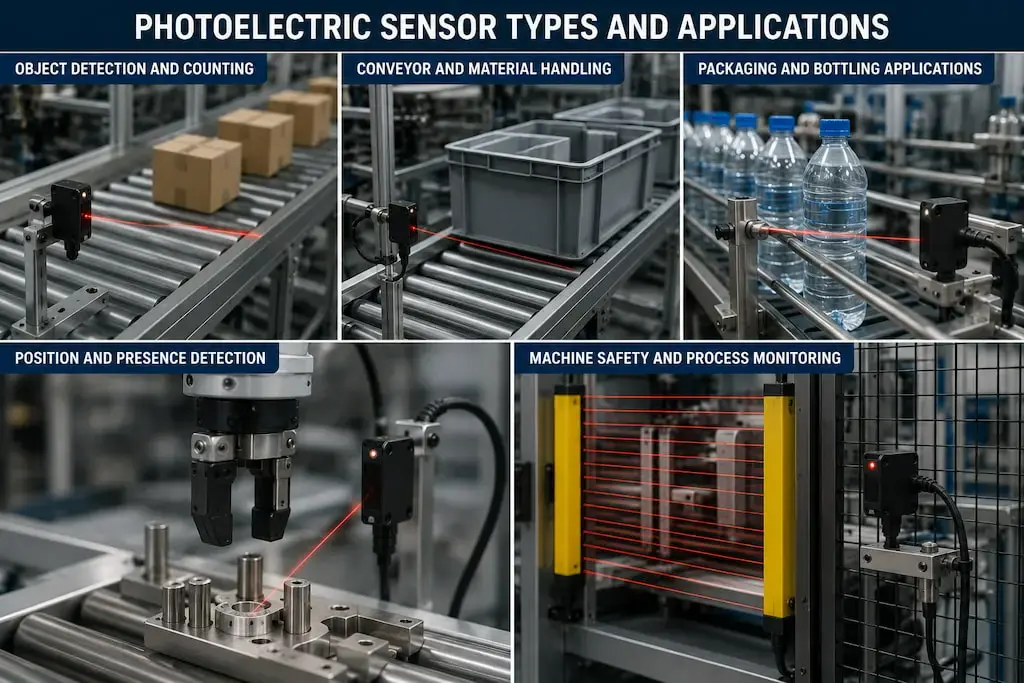
Understanding photoelectric sensor types and applications helps match sensing technology to actual operating conditions.
Object Detection and Counting
Sensors detect passing components and count products during automated production.
Conveyor and Material Handling Systems
Photoelectric sensors identify products, control conveyor sequences and monitor material movement.
Packaging and Bottling Applications
Sensors detect containers, labels, packages and product position at high production speeds.
Position and Presence Detection
They verify whether components are correctly positioned before subsequent machine operations begin.
Machine Safety and Process Monitoring
Photoelectric sensing can support process monitoring and presence verification. Safety functions, however, require devices specifically rated and designed for safety applications.
How to Choose the Right Photoelectric Sensor
Sensor selection should begin with application requirements rather than a preferred model or brand. BSP Automation supplies products from manufacturers including IFM sensors, ABB sensors and Pepperl and Fuchs sensors.
Consider the Sensing Distance
Determine the minimum and maximum distances between the sensor and target under actual operating conditions.
Evaluate the Target Material and Surface
Color, transparency, reflectivity, shape and surface finish can influence optical detection.
Check Ambient Light and Environmental Conditions
Dust, moisture, vibration, temperature and strong ambient light should be considered before selecting a sensor.
Consider Available Installation Space
Verify mounting clearance, sensor dimensions, cable routing and alignment access.
Verify Output and Electrical Requirements
Confirm voltage, PNP or NPN output, connector type and compatibility with the control system.
Consider Response Time and Switching Frequency
High-speed counting and packaging require sensors capable of detecting targets at the necessary machine cycle rate.
Photoelectric Proximity Sensor Types: What Should You Consider?
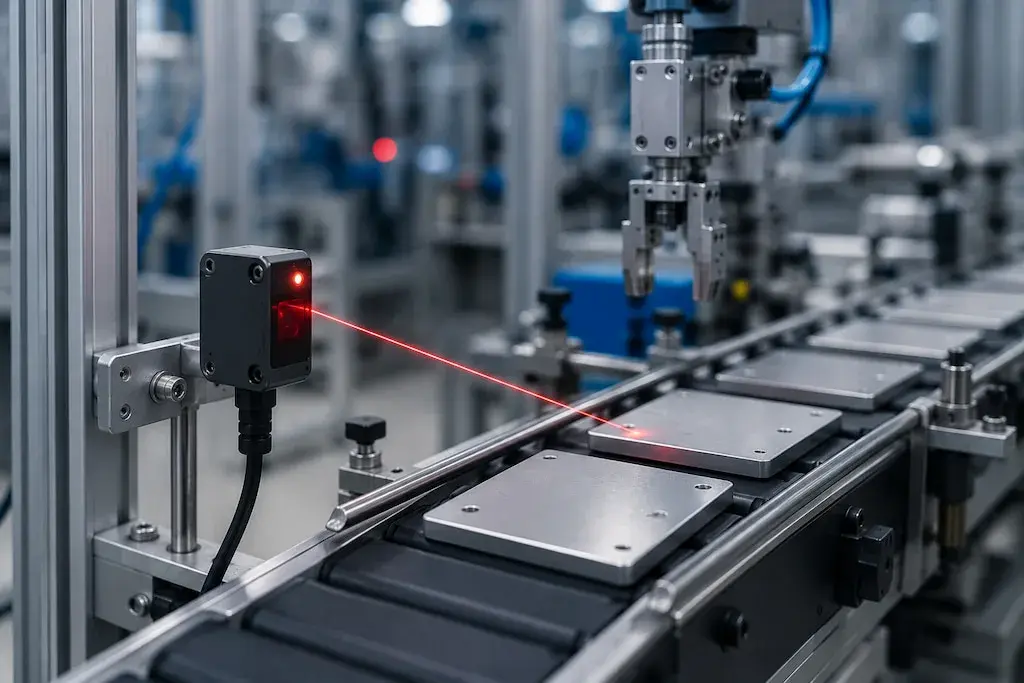
Different photoelectric proximity sensor types provide non-contact detection without relying on the electromagnetic principles used by conventional proximity sensors.
Detection Method and Target Characteristics
Choose a sensing principle appropriate for the object's material, surface, color and geometry. This ensures reliable detection performance across varying production conditions and reduces the risk of false triggering.
Sensing Range and Accuracy
Consider both required distance and positioning precision. It is also important to account for real-world tolerances such as vibration or target movement that may affect measurement stability.
Installation and Alignment Requirements
Through-beam systems require alignment between two devices, while diffuse sensors can simplify mounting. Proper alignment during setup is critical to maintaining consistent long-term performance and minimizing signal loss.
Common Photoelectric Sensor Selection Mistakes
Incorrect sensor selection can cause intermittent detection and unnecessary downtime. These issues often lead to increased maintenance costs and reduced overall system efficiency.
Choosing Only by Sensing Range
Maximum range alone does not indicate whether a sensor will reliably detect a particular target. Other factors such as target reflectivity and environmental conditions must also be evaluated for accurate performance.
Ignoring Target Color and Reflectivity
Dark, shiny, transparent, or irregular objects may require specialized sensing methods. Failing to account for these properties can result in missed detections or unstable switching behavior.
Overlooking Dust, Moisture, or Ambient Light
Environmental conditions can reduce optical performance or contaminate sensor lenses. Regular maintenance and proper housing selection can help mitigate these effects in harsh environments.
Failing to Check Electrical Specifications
Incorrect voltage or output configuration can prevent proper integration with controllers listed in the complete AB PLC models list. This mismatch can also lead to signal instability or damage to connected components.
Comparing Different Photoelectric Sensor Types
A practical comparison helps narrow the available options. It allows engineers to match sensor capabilities more precisely to application requirements.
Through-Beam Sensors
They offer long range and high detection reliability but require separate emitter and receiver installation. They work well for conveyors and demanding metal manufacturing environments.
Retro-Reflective Sensors
These use a reflector and provide simpler installation than through-beam systems. Typical applications include packaging and material handling.
Diffuse-Reflective Sensors
Diffuse sensors detect reflections directly from targets without separate reflectors. They are useful for short-range presence and position detection.
Background Suppression Sensors
These sensors reduce interference from background objects, making them effective for positioning and assembly applications requiring more precise target discrimination.
Which Photoelectric Sensor Type Is Right for Your Application?
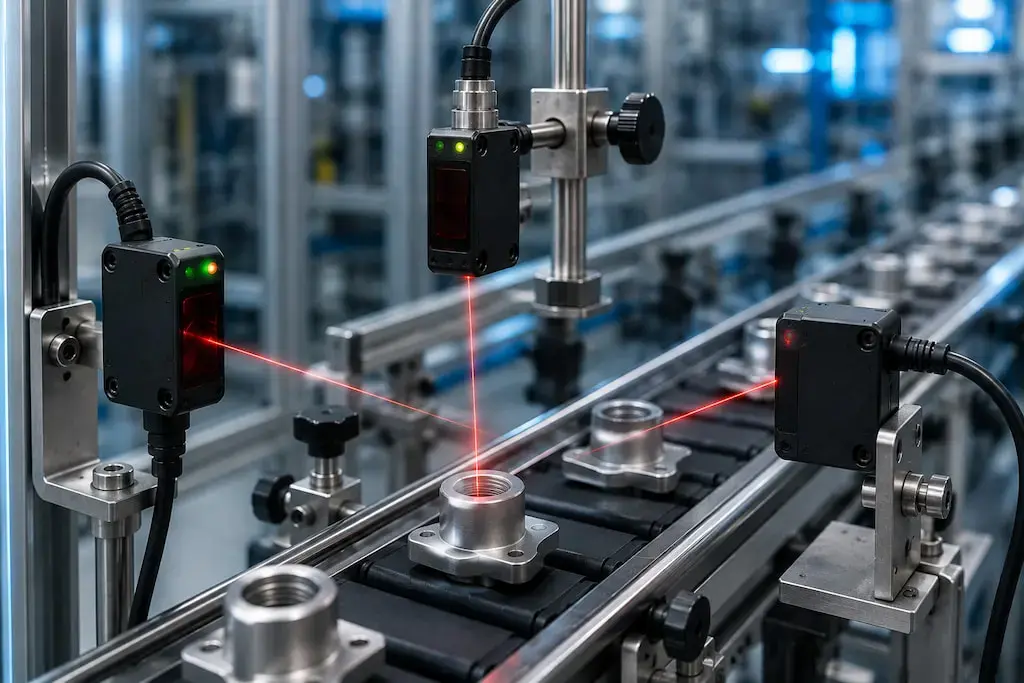
The correct choice depends on sensing distance, target characteristics, mounting conditions, environment and required accuracy.
Choose Through-Beam for Long-Range, Reliable Detection
Use through-beam sensing when maximum range and dependable object detection are priorities.
Choose Retro-Reflective for Straightforward Object Detection
Choose retro-reflective sensing when good range is required but installing a powered receiver opposite the sensor is impractical.
Choose Diffuse for Flexible Short-Range Detection
Diffuse sensors suit compact installations where targets provide sufficient reflected light.
Choose Background Suppression for Precise Target Detection
Background suppression is preferable when nearby surfaces could interfere with accurate detection.
Before purchasing, verify the manufacturer's technical specifications and compatibility with existing Allen-Bradley parts, controllers, networks and Allen-Bradley HMI equipment. BSP Automation can assist with sourcing industrial sensors and automation components.
FAQ
The primary types are through-beam, retro-reflective, diffuse-reflective and background suppression sensors.
Through-beam sensors generally provide the longest sensing distance because light travels directly between separate emitter and receiver units.
Through-beam sensors use separate powered emitter and receiver devices. Retro-reflective sensors place both functions in one housing and use a reflector.
Use one for short-range presence or position detection when simple installation without a separate reflector is beneficial.
The correct technology depends on the object's reflectivity and geometry. Polarized retro-reflective or specialized sensors may improve detection of highly reflective targets.
Yes, but target color can change the amount of reflected light, particularly with diffuse sensors.
Evaluate sensing range, target properties, environment, response time, mounting space, electrical compatibility and control architecture. Network and controller requirements may also matter in systems using Profinet / Ethernet/IP technologies or equipment from Top PLC brands.



Have a question?
If you didn't find the automation part you were looking for, our support team is here to help. Just contact us, and we'll do our best to source the exact part you need. We're committed to meeting your needs and ensuring your satisfaction.
Contact Us Now