Table of Content
Profinet vs Ethernet/IP: Key Differences Explained

Written by
Artur Solakhyan
Freelance copywriter and editor
Published at8 July 2026
Estimated reading time4 min read
Share This:
Industrial Ethernet has become the backbone of modern automation systems, replacing many traditional fieldbus technologies with faster, more flexible communication networks. Selecting the right protocol directly affects network reliability, real-time communication, PLC performance, diagnostics, scalability and compatibility with automation equipment. Two of the most widely used Industrial Ethernet standards are PROFINET and Ethernet/IP. While both provide high-speed communication between controllers and field devices, they differ in architecture, configuration methods, vendor ecosystems and typical applications. This guide compares Profinet vs Ethernet/IP, helping engineers, system integrators and plant managers understand which protocol best suits their automation requirements.
What Is an Industrial Ethernet Protocol?
Industrial Ethernet protocols are communication standards designed specifically for industrial automation. They build upon standard Ethernet technology while adding deterministic communication, diagnostics and reliability required for factory environments.
Unlike traditional fieldbus systems, Industrial Ethernet supports:
- Higher communication speeds
- Larger device counts
- Remote diagnostics
- Integration with enterprise systems
- Flexible network expansion
Today, industrial network protocols form the communication backbone of Industry 4.0, enabling PLCs, HMIs, drives, sensors, robots and SCADA systems to exchange data across modern industrial communication networks.
What Is the PROFINET Protocol?
The Profinet protocol was developed by PROFIBUS & PROFINET International (PI) as an Industrial Ethernet standard for factory automation.
It is widely used in:
- Manufacturing
- Automotive production
- Packaging
- Food processing
- Pharmaceutical plants
Its architecture supports deterministic communication, making it suitable for demanding automation and motion control applications.
How PROFINET Works
PROFINET communicates over Ethernet while providing deterministic data exchange between controllers and field devices.
Devices communicate through:
- Controllers
- I/O devices
- Supervisory engineering stations
This architecture allows rapid data transfer and centralized network management.
PROFINET Communication Classes
PROFINET supports several communication modes:
TCP/IP
Used for configuration, diagnostics and standard data exchange.
RT (Real-Time)
Provides deterministic communication suitable for most industrial automation tasks.
IRT (Isochronous Real-Time)
Designed for extremely fast, synchronized communication required in robotics and motion control.
Advantages of PROFINET
Major benefits include:
- Very fast communication
- Excellent motion control support
- Comprehensive diagnostics
- Flexible network topology
- Straightforward engineering and commissioning
Limitations of PROFINET
Potential limitations include:
- More complex configuration for advanced systems
- Strong association with specific automation ecosystems
- Higher engineering requirements for IRT applications
What Is the Ethernet/IP Protocol?
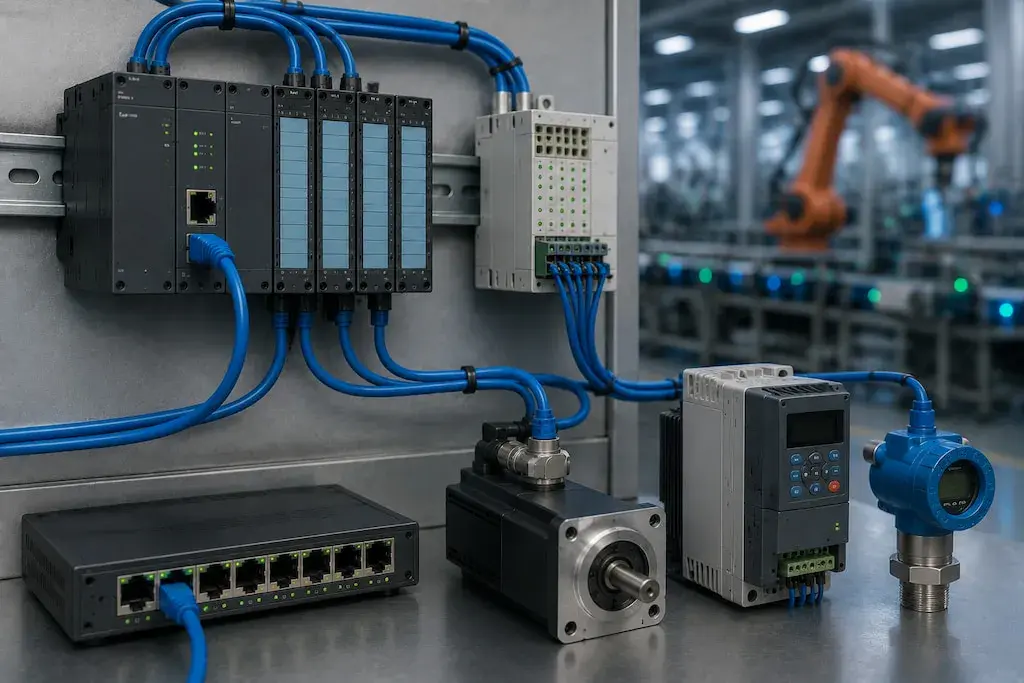
The Ethernet/IP Protocol was developed by ODVA and is based on the Common Industrial Protocol (CIP). It uses standard Ethernet hardware while extending communication capabilities for industrial automation.
Ethernet/IP is widely used throughout North America and is strongly associated with Allen-Bradley automation platforms.
How Ethernet/IP Works
Ethernet/IP uses TCP/IP networking together with CIP messaging.
Communication includes:
- Explicit messaging for configuration
- Implicit messaging for real-time I/O
- CIP object-based communication
This architecture supports efficient communication between controllers, drives, HMIs and field devices.
Advantages
Ethernet/IP offers several advantages:
- Open communication standard
- Large vendor ecosystem
- Simple integration with Ethernet infrastructure
- Extensive adoption across industrial automation
Limitations
Limitations may include:
- Greater network traffic in large systems
- More attention required for deterministic performance
- Cybersecurity considerations associated with Ethernet networks
PROFINET vs Ethernet/IP: Key Differences
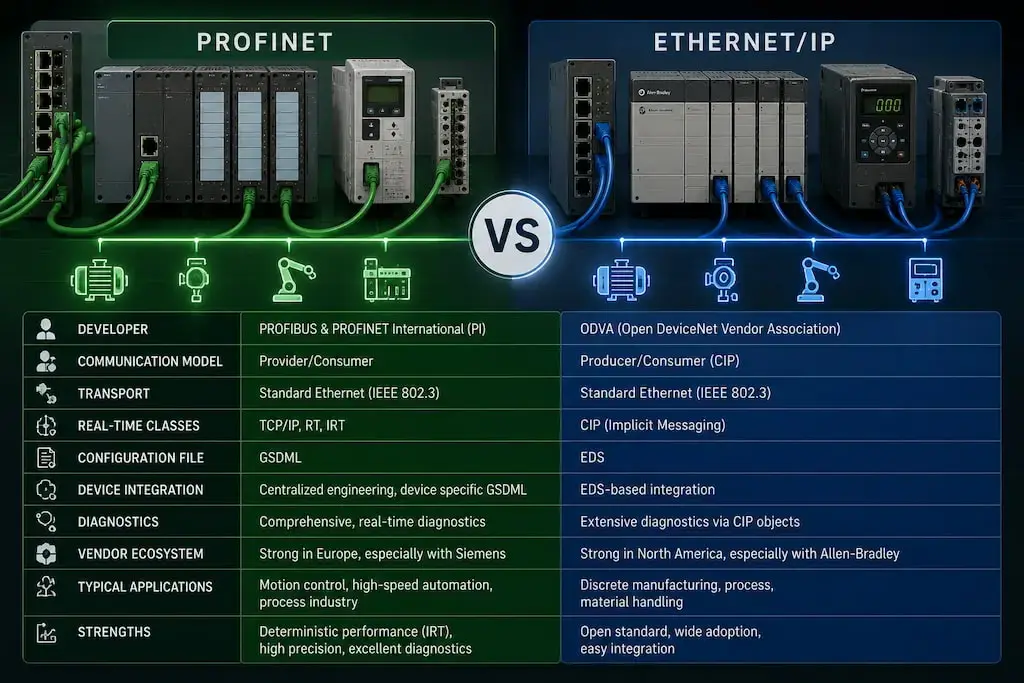
Both protocols are leading Industrial Ethernet standards, but they differ in communication architecture, performance, vendor support and deployment strategies. When comparing Profinet vs Ethernet/IP, the best solution depends on the automation environment rather than one protocol being universally better.
Communication Architecture
PROFINET uses a provider-consumer communication model optimized for deterministic data exchange.
Ethernet/IP relies on the Common Industrial Protocol (CIP) using producer-consumer messaging across Ethernet networks.
Real-Time Performance
Both protocols support real-time communication.
PROFINET IRT generally provides lower latency for demanding motion control applications, while Ethernet/IP delivers excellent performance for most manufacturing environments.
Configuration and Device Integration
PROFINET devices are configured using GSDML files.
Ethernet/IP devices use EDS files for device configuration and integration.
Both approaches simplify engineering once the appropriate software environment is established.
Diagnostics and Network Monitoring
Each protocol offers comprehensive diagnostics including:
- Device health monitoring
- Fault detection
- Alarm reporting
- Maintenance information
Advanced diagnostics help reduce unplanned downtime.
Vendor Ecosystem and Compatibility
Protocol selection frequently depends on existing automation infrastructure. PROFINET is commonly associated with Siemens platforms. Ethernet/IP is widely used with Allen-Bradley systems, including numerous products listed in the complete AB PLC models list. Safety manufacturers such as Schmersal also support Industrial Ethernet communication across many product families.
Scalability and Network Flexibility
Both protocols support:
- Small machine networks
- Large manufacturing facilities
- Distributed control systems
- Future expansion
Ethernet infrastructure makes both highly scalable for modern automation.
Typical Applications
PROFINET is frequently used in:
- Automotive manufacturing
- Packaging
- Pharmaceutical production
- High-speed motion systems
Ethernet/IP commonly appears in:
- Material handling
- Oil and gas
- Water treatment
- Logistics
- General manufacturing
Which Protocol Is Better?
Neither protocol is universally superior.
The best choice depends on:
- Existing PLC platform
- Communication speed requirements
- Motion control demands
- Preferred automation vendor
- Network size
- Long-term maintenance strategy
Real-Time Performance Comparison
Real-time communication remains one of the primary reasons manufacturers adopt Industrial Ethernet.
Both protocols support:
- Cyclic communication
- Deterministic networking
- High-speed update rates
- Motion control
PROFINET IRT generally achieves lower latency for tightly synchronized applications, while Ethernet/IP delivers excellent performance for most production systems using managed network infrastructure.
Diagnostics and Troubleshooting
Both protocols provide advanced diagnostic capabilities.
Features typically include:
- Device diagnostics
- Predictive maintenance support
- Network fault detection
- Alarm handling
- Status monitoring
These capabilities improve equipment reliability across large industrial communication networks.
PLC Compatibility and Vendor Support
Most major automation manufacturers support one or both protocols.
Examples include:
- Siemens
- Allen-Bradley
- Schneider Electric
- Phoenix Contact
- Beckhoff
- Omron
Organizations typically choose protocols that align with their installed automation ecosystem.
Which Industries Commonly Use Each Protocol?

PROFINET Applications
PROFINET is widely deployed in:
- Automotive manufacturing
- Food processing
- Pharmaceutical production
- Packaging systems
- General manufacturing
Ethernet/IP Applications
Ethernet/IP is commonly used in:
- Automotive production
- Oil and gas
- Material handling
- Logistics facilities
- Water treatment plants
It also integrates naturally with Allen-Bradley automation platforms.
How They Fit into Modern PLC Communication Protocols
Modern PLC communication protocols extend well beyond controller-to-controller communication.
Both PROFINET and Ethernet/IP support integration with:
- PLCs
- SCADA systems
- HMIs
- IIoT platforms
- Remote monitoring
- MES software
As automation systems continue evolving, Industrial Ethernet remains central to digital manufacturing initiatives.
Can PROFINET and Ethernet/IP Work Together?
Yes. Hybrid automation systems often combine both protocols through:
- Industrial protocol gateways
- Protocol converters
- Managed Ethernet switches
These solutions simplify migration projects while preserving existing equipment investments.
Factors to Consider When Choosing Between PROFINET and Ethernet/IP
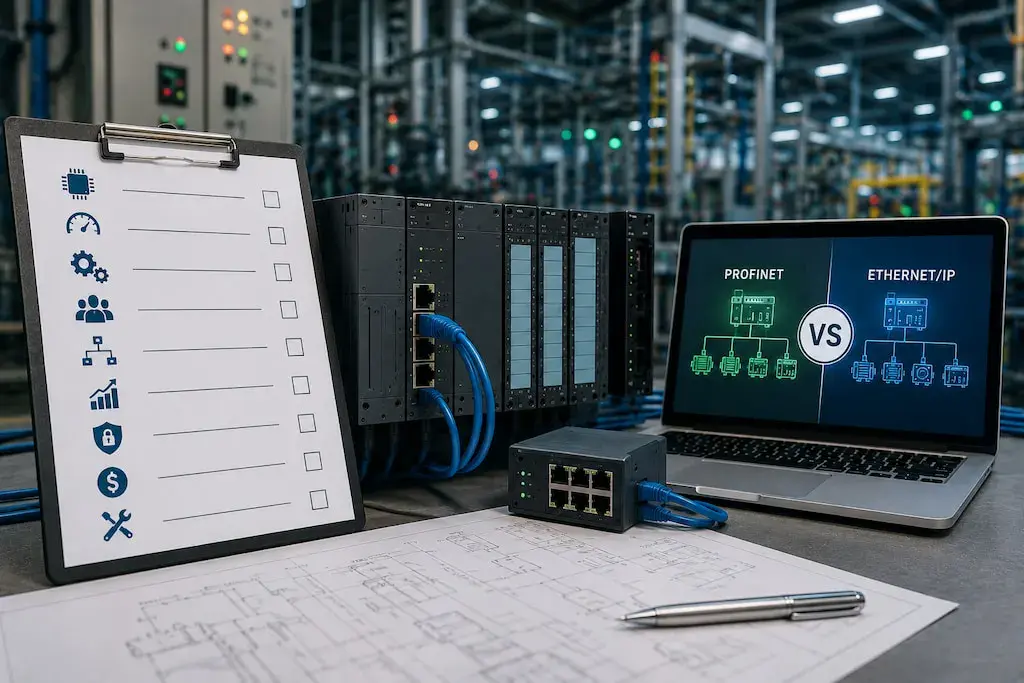
Before selecting a protocol, evaluate:
- Existing PLC platform
- Required communication speed
- Motion control requirements
- Vendor ecosystem
- Network size
- Future expansion plans
- Cybersecurity requirements
- Available maintenance expertise
- Overall project budget
Reviewing key industrial automation terms can also help engineers understand communication technologies during project planning.
Future Trends in Industrial Ethernet Protocols
Industrial Ethernet continues evolving alongside digital manufacturing technologies.
Key trends include:
- Time-Sensitive Networking (TSN)
- Industrial IoT integration
- AI-driven diagnostics
- Cloud connectivity
- OPC UA interoperability
- Edge computing
These technologies will continue improving communication reliability, system visibility and predictive maintenance capabilities.
As a global automation parts supplier, BSP Automation supplies Industrial Ethernet components, AB controllers, communication hardware, PLC systems and automation products from leading manufacturers.
FAQ
For highly synchronized motion control applications, PROFINET IRT generally delivers lower latency. In most industrial applications, however, both protocols provide excellent performance.
The answer depends on geographic region and installed automation platforms. PROFINET is particularly common in Europe, while Ethernet/IP has widespread adoption throughout North America.
Yes. Many Siemens controllers can communicate over Ethernet/IP using supported communication modules or gateways, depending on the application.
Yes. Allen-Bradley controllers can participate in PROFINET networks through compatible communication modules or protocol gateways where required.
PROFINET IRT is generally preferred for highly synchronized motion control, although Ethernet/IP also supports advanced motion applications through CIP Motion.
Yes. Both PROFINET and Ethernet/IP are leading Industrial Ethernet standards used throughout modern manufacturing.
Yes. Hybrid systems commonly combine both protocols using gateways, managed switches and industrial networking equipment to connect different automation platforms.



Have a question?
If you didn't find the automation part you were looking for, our support team is here to help. Just contact us, and we'll do our best to source the exact part you need. We're committed to meeting your needs and ensuring your satisfaction.
Contact Us Now