Table of Content
Everything You Need to Know About Allen-Bradley Servo Drives

Written by
Artur Solakhyan
Freelance copywriter and editor
Published at12 August 2026
Estimated reading time5 min read
Share This:
An Allen-Bradley servo drive provides precise control of motor position, speed and torque in automated machinery. These drives are widely used where standard motor control cannot provide the accuracy, response time, or synchronization required by the application. Combined with Allen-Bradley controllers, servo motors, feedback devices and industrial networks, they form integrated motion systems for applications ranging from packaging equipment to robotics. This guide covers how servo drives work, major Kinetix families, applications, selection criteria, installation, troubleshooting and maintenance.
What Are AB Servo Drives?
AB servo drives are Allen-Bradley electronic motion-control devices that regulate power supplied to servo motors. They receive commands from a controller and continuously adjust motor operation using feedback data.
A servo motor produces mechanical motion, while the drive regulates that motor. A motion controller generates commands and an encoder reports actual movement. Together, these devices create a closed-loop servo system capable of precise positioning and repeatable operation.
How Do AB Servo Drives Work?
The controller sends a position, velocity, or torque command to the servo drive. The drive supplies controlled electrical power to the motor while continuously receiving encoder feedback.
It compares the requested movement with actual motor behavior and makes rapid corrections. This closed-loop process allows accurate control of:
- Position
- Speed
- Acceleration
- Torque
Communication between the PLC, drive and other automation devices may occur through EtherNet/IP and related industrial networks. Our Profinet vs Ethernet/IP guide provides additional context on these network technologies.
Main Components of an AB Servo System
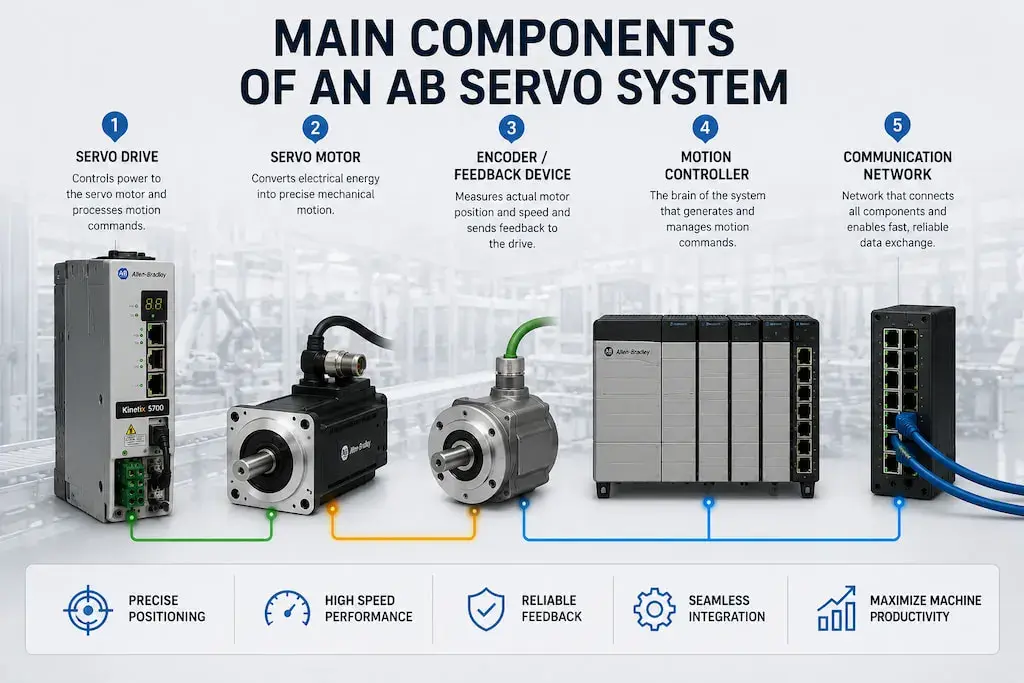
Servo Drive
The drive processes motion commands and regulates electrical power delivered to the motor.
Servo Motor
The servo motor converts electrical energy into controlled mechanical movement.
Encoder / Feedback Device
An encoder measures actual motor position and speed, providing the feedback required for closed-loop control.
Motion Controller
The controller executes machine logic and coordinates motion. Engineers comparing controller platforms can consult the Complete AB PLC models list.
Communication Network
The network exchanges motion commands, status information, diagnostics and synchronization data between automation components.
Key Features of AB Servo Drives
Modern Allen-Bradley servo drives combine precise motion control with integration into Rockwell Automation control architectures.
High-Speed Motion Control
Fast processing allows drives to respond rapidly to changing motion commands.
Precise Positioning Accuracy
Encoder feedback supports repeatable positioning for assembly, robotics, cutting and packaging.
Torque Control
Accurate torque regulation helps protect products and mechanical equipment.
Energy Efficiency
Properly sized servo systems use power according to motion demand and may support energy-saving system designs.
Built-in Diagnostics
Diagnostic functions help maintenance teams identify faults and monitor drive conditions.
Safety Functions
Selected Kinetix platforms provide integrated safety capabilities for appropriately designed machinery.
Multi-Axis Synchronization
Multiple servo axes can be coordinated for complex machine sequences.
EtherNet/IP Connectivity
EtherNet/IP integration simplifies communication with compatible Allen-Bradley controllers and other networked equipment.
Types of AB Servo Drives
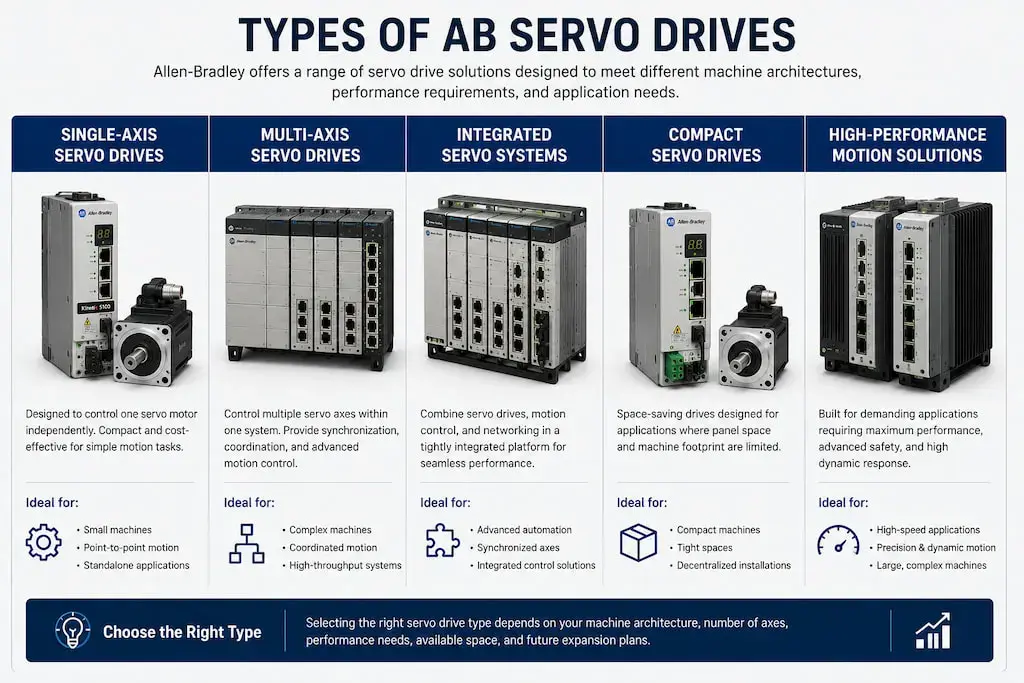
Allen-Bradley offers servo solutions for different machine architectures. Single-axis drives suit independent motion tasks, while multi-axis platforms coordinate several motors within one machine. Compact drives are appropriate where cabinet space and machine size are limited.
Integrated and high-performance motion platforms address applications requiring synchronized axes, higher power, safety functions, or demanding dynamic performance. Selection should therefore reflect the machine architecture rather than drive power alone.
Popular Allen-Bradley Servo Drive Series
Kinetix 300
Kinetix 300 drives were designed for lower-axis-count positioning applications. They are commonly encountered in smaller machines and existing installations.
Kinetix 5100
Kinetix 5100 provides flexible servo control for standalone and coordinated applications. It suits machines requiring precise motion without the architecture of a larger multi-axis platform.
Kinetix 5300
Kinetix 5300 targets modern machine-level applications requiring integrated motion control, compact installation and EtherNet/IP connectivity.
Kinetix 5500
Kinetix 5500 supports integrated motion applications and is suited to medium and more demanding machine architectures requiring coordinated axes.
Kinetix 5700
Kinetix 5700 is intended for high-performance, multi-axis machine systems. It is appropriate for larger equipment requiring advanced motion, synchronization and integrated control.
Kinetix 6500
Kinetix 6500 systems are found in applications requiring integrated motion and network-based control within established Allen-Bradley architectures.
Kinetix 6200 (Legacy)
Kinetix 6200 equipment remains present in installed machinery. When maintaining legacy systems, availability, compatibility, lifecycle status and migration planning should all be evaluated before replacement.
Common Applications of AB Servo Drives
Packaging Machinery
Servo drives coordinate filling, labeling, sealing, indexing and cutting operations.
Robotics
Precise position and torque control supports repeatable robotic movement.
CNC Machines
Servo systems control axes requiring accurate positioning and controlled acceleration.
Material Handling Systems
Servo drives support indexing, sorting, positioning and synchronized conveyor operations.
Food and Beverage Manufacturing
In food and beverage facilities, servo systems are used in filling, packaging, processing and handling machinery.
Automotive Production
Applications include robotic assembly, positioning, material transfer and component handling.
Pharmaceutical Manufacturing
Servo motion supports accurate filling, dosing, packaging and product handling.
Printing and Converting Equipment
Synchronized motion helps control registration, tension, cutting and material feeding.
Semiconductor Manufacturing
High positioning accuracy makes servo systems suitable for sensitive handling and production equipment.
Advantages of Using AB Servo Drives
The primary advantages of Allen-Bradley servo drives include high accuracy, fast production cycles, repeatable movement, controlled acceleration and synchronized multi-axis operation.
Integration with Allen-Bradley controllers and Allen-Bradley HMI systems can also simplify machine diagnostics and operator interaction. Correctly configured systems can reduce unnecessary mechanical stress while supporting future machine expansion.
AB Servo Drives vs Variable Frequency Drives (VFDs)
A VFD primarily regulates AC motor speed and torque by adjusting supplied frequency and voltage. Servo drives use closed-loop feedback to provide considerably more precise position, speed and torque control.
VFDs are generally suitable for pumps, fans, conveyors and other applications where exact positioning is unnecessary. Servo drives are preferable for robotics, synchronized packaging machinery, CNC axes and other precision-motion applications.
Servo systems typically involve higher initial costs, but the additional control capability is justified when machine performance depends on accuracy and rapid dynamic response.
How to Choose the Right Allen-Bradley Servo Drives
Proper Allen-Bradley servo drive selection requires evaluating the entire motion system.
Motor Compatibility
Confirm that the motor and drive are electrically and functionally compatible.
Required Torque
Calculate continuous and peak torque requirements under actual operating loads.
Required Speed
Select equipment capable of reaching the required operating speed without exceeding system limits.
Power Rating
Drive capacity must match motor and application demands.
Voltage Requirements
Confirm compatibility with the facility's available electrical supply.
Encoder Compatibility
Verify that the drive supports the motor's feedback technology.
Communication Protocols
Consider controller communication and the existing machine network.
Environmental Conditions
Evaluate temperature, contamination, vibration and enclosure requirements. Suitable Allen-Bradley boxes enclosures can support proper component protection.
Safety Requirements
Identify required machine safety functions during system design.
Future Expansion
Allow for additional axes, I/O, networking, or production requirements where expansion is expected.
Installation Best Practices for AB Servo Drives
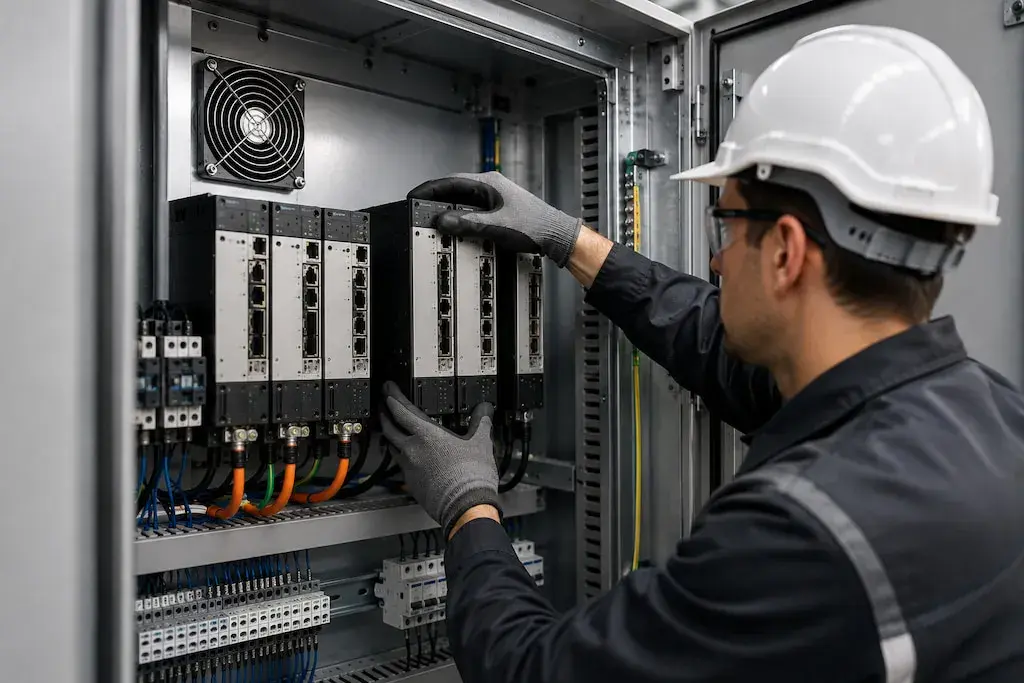
Install drives according to manufacturer specifications for mounting orientation, spacing, ventilation, grounding and electrical protection. Use suitable wire cables and maintain separation between power and sensitive signal wiring where required. Before commissioning, verify motor connections, feedback wiring, network configuration, safety circuits, firmware compatibility and drive parameters. Proper grounding and cable routing are particularly important for reducing electrical noise.
Common Allen-Bradley Servo Drive Faults Troubleshooting
Encoder Errors
Inspect feedback cables, connectors, encoder configuration and the feedback device.
Overcurrent Faults
Check for mechanical binding, excessive acceleration, incorrect motor parameters, or electrical faults.
Overvoltage Alarms
Inspect supply conditions and regenerative energy during deceleration.
Overheating Issues
Check ventilation, ambient temperature, drive loading and cooling conditions.
Communication Errors
Verify network cables, addressing, controller configuration and communication status.
Motor Feedback Problems
Inspect encoder connections and confirm compatible feedback configuration.
Positioning Errors
Review mechanical loading, tuning, encoder feedback and motion programming.
Startup Issues
Confirm incoming power, safety states, motor configuration, firmware and controller communication.
Maintenance Tips to Extend the Life of Servo Drives
Regularly inspect drives for contamination, abnormal temperatures, damaged connections and cooling problems. Keep cabinets clean and verify that fans and ventilation paths remain functional.
Monitor diagnostic information for developing faults and inspect electrical connections during scheduled maintenance. Firmware changes should be planned carefully and checked for compatibility. Predictive maintenance can further reduce unexpected failures by identifying changes in temperature, load, vibration and fault frequency.
Genuine vs Surplus vs Refurbished Allen-Bradley Servo Drives
New genuine drives are generally preferable for current installations requiring manufacturer support and predictable lifecycle availability. Surplus equipment can be useful when a genuine component is required for an established system but availability through standard channels is limited.
Refurbished drives can provide another option for maintaining older machinery, provided their condition, testing process and warranty are understood. Obsolete models may be necessary when immediate migration is impractical.
When sourcing Allen-Bradley parts, buyers should verify exact catalog numbers, specifications, condition and compatibility before purchase. BSP Automation supports industrial customers sourcing current and legacy automation components across major manufacturers. For broader controller comparisons, see our guide to top PLC brands.
FAQ
They control servo motors in applications requiring accurate position, speed, torque and synchronized motion.
They receive motion commands, regulate power to the servo motor and use encoder feedback to continuously correct motor operation.
The servo drive controls electrical power and motion behavior. The servo motor converts that controlled power into mechanical movement.
Servo drives specialize in precise closed-loop motion control. VFDs are commonly used for general AC motor speed control where exact positioning is not required.
Selection depends on axis count, motor compatibility, power, motion performance, controller architecture, safety requirements and machine size.
Service life varies according to operating load, temperature, contamination, installation quality, duty cycle and maintenance conditions.
Many servo drives can be professionally repaired, although repair viability depends on the model, failure, component availability and lifecycle status.
Common causes include incorrect configuration, encoder problems, overcurrent, excessive voltage, overheating, communication failures, wiring faults and mechanical issues.
Inspection intervals should follow manufacturer guidance and facility maintenance schedules, with more frequent checks in demanding operating environments.
Yes, some discontinued drives remain available through independent industrial suppliers, surplus inventories and refurbishment channels. Exact availability depends on the catalog number and market supply.




Have a question?
If you didn't find the automation part you were looking for, our support team is here to help. Just contact us, and we'll do our best to source the exact part you need. We're committed to meeting your needs and ensuring your satisfaction.
Contact Us Now