Table of Content
How to Connect Festo Pneumatics to an Allen-Bradley PLC System

Written by
Artur Solakhyan
Freelance copywriter and editor
Published at28 May 2026
Estimated reading time4 min read
Share This:
Pneumatic automation remains one of the most common motion technologies in modern manufacturing. From packaging equipment to assembly stations and food processing lines, pneumatic cylinders and valve systems provide reliable movement while PLCs manage logic, sequencing and monitoring. Integrating Festo pneumatic systems with Allen-Bradley PLC platforms has become a standard approach for industrial automation projects because it combines proven pneumatic technology with advanced control capabilities. This guide covers pneumatic system fundamentals, PLC communication, wiring, configuration, troubleshooting and best practices for successful integration.
Understanding the Basics of Festo Pneumatic Systems
A pneumatic automation system uses compressed air to generate motion and control mechanical processes. Typical systems include pneumatic cylinders, solenoid valves, valve terminals, air preparation units, sensors and actuators.
Common Festo Components Used in PLC Automation
Commonly integrated Festo pneumatic automation components include:
- Valve terminals
- Pneumatic actuators
- Position sensors
- Remote I/O modules
- CPX automation platforms
Festo CPX systems are particularly useful because they support modern communication networks and simplify integration with PLC platforms.
Advantages of Pneumatic Automation in Industrial Applications
Pneumatic systems remain popular because they offer:
- Fast actuation speeds
- Reliable operation
- Low maintenance requirements
- Cost-effective motion control
- Clean operation suitable for regulated industries
These advantages make pneumatics a strong choice for packaging, assembly and processing applications.
Overview of Allen Bradley PLC Systems
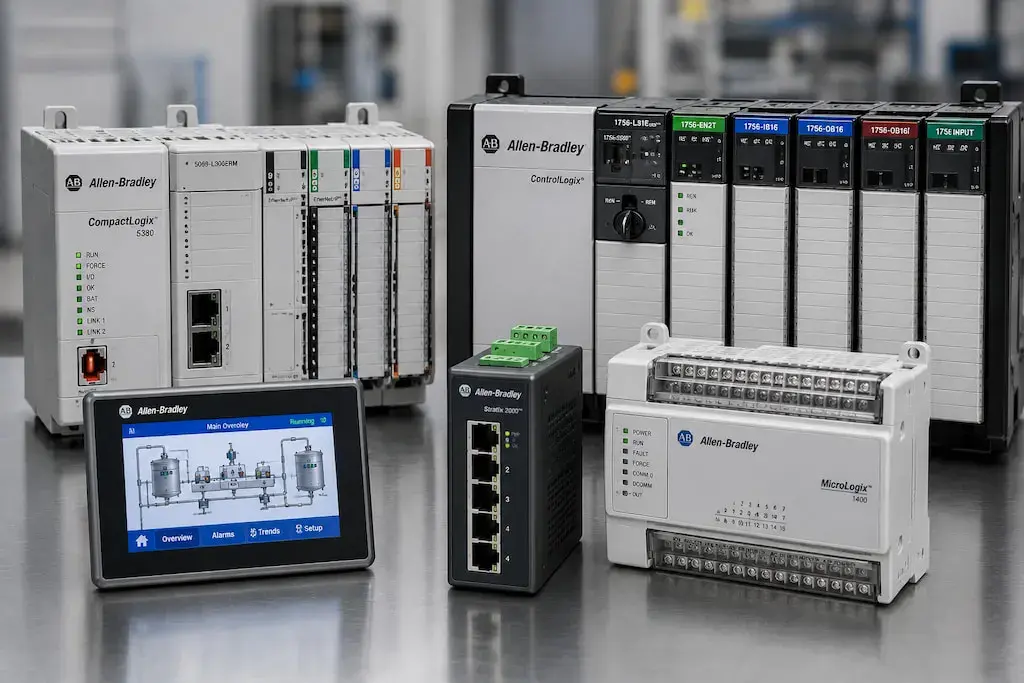
Allen-Bradley PLC platforms commonly used with pneumatic systems include CompactLogix, ControlLogix and MicroLogix controllers. These systems provide digital inputs and outputs, Ethernet/IP communication, ladder logic programming and centralized machine control.
How PLCs Control Pneumatic Devices
PLCs control pneumatic equipment through digital outputs connected to solenoid valves. When a PLC output activates, the valve changes state and directs compressed air to a cylinder. Sensors installed on cylinders then send position feedback signals to PLC inputs, allowing the controller to verify movement and continue the programmed sequence.
Required Components for Connecting Festo Pneumatics to Allen Bradley PLCs
Pneumatic Components
A typical system requires:
- Pneumatic cylinders
- Solenoid valves
- Air preparation units
- Tubing and fittings
Electrical and Control Components
The control architecture generally includes:
- Allen-Bradley PLC
- Power supply
- Terminal blocks
- Relays
- Industrial Ethernet switches
- I/O modules
Communication Protocols and Interfaces
Several industrial communication protocols are commonly used:
- Ethernet/IP
- IO-Link
- Digital I/O
- PROFINET in mixed-vendor environments
Among the various types of industrial communication protocols, Ethernet/IP is the most common when integrating Festo systems with Allen-Bradley controllers. Proper network infrastructure and AB PLC ethernet connectors help ensure stable communication.
Step-by-Step Guide to Connecting Festo Pneumatics to an Allen Bradley PLC System
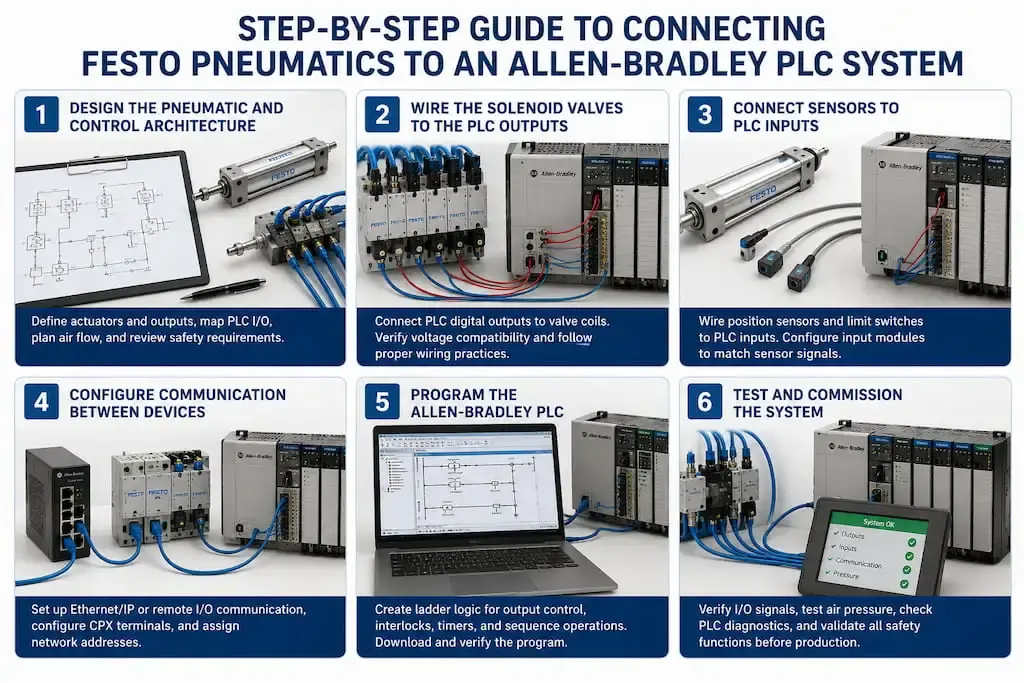
Step 1 - Design the Pneumatic and Control Architecture
Start by identifying all actuators, valves, sensors and outputs. Map PLC I/O requirements, plan air distribution and evaluate safety requirements. A clear design reduces commissioning time and future troubleshooting.
Step 2 - Wire the Solenoid Valves to the PLC Outputs
Connect PLC digital outputs to valve coils according to manufacturer specifications. Verify voltage compatibility and use proper wiring practices. Protective devices and safety procedures should always be incorporated into the design.
Step 3 - Connect Sensors to PLC Inputs
Cylinder position sensors and limit switches provide feedback to the PLC. These signals help verify cylinder position and ensure sequence accuracy. Configure input modules correctly to match sensor characteristics.
Step 4 - Configure Communication Between Devices
When using Ethernet/IP or remote I/O systems, configure:
- Network addressing
- Device parameters
- Festo CPX terminal settings
- Communication paths
Reliable industrial ethernet protocols play a major role in maintaining stable machine performance.
Step 5 - Program the Allen Bradley PLC
Develop ladder logic that controls outputs and processes sensor feedback. Programs commonly include:
- Output activation
- Interlocks
- Timers
- Sequence control
- Fault handling
Proper programming ensures predictable machine behavior and easier maintenance.
Step 6 - Test and Commission the System
Before production starts:
- Verify input and output signals
- Check air pressure levels
- Review PLC diagnostics
- Validate safety functions
A structured commissioning process helps identify issues before full operation begins.
Common Integration Challenges and Troubleshooting Tips
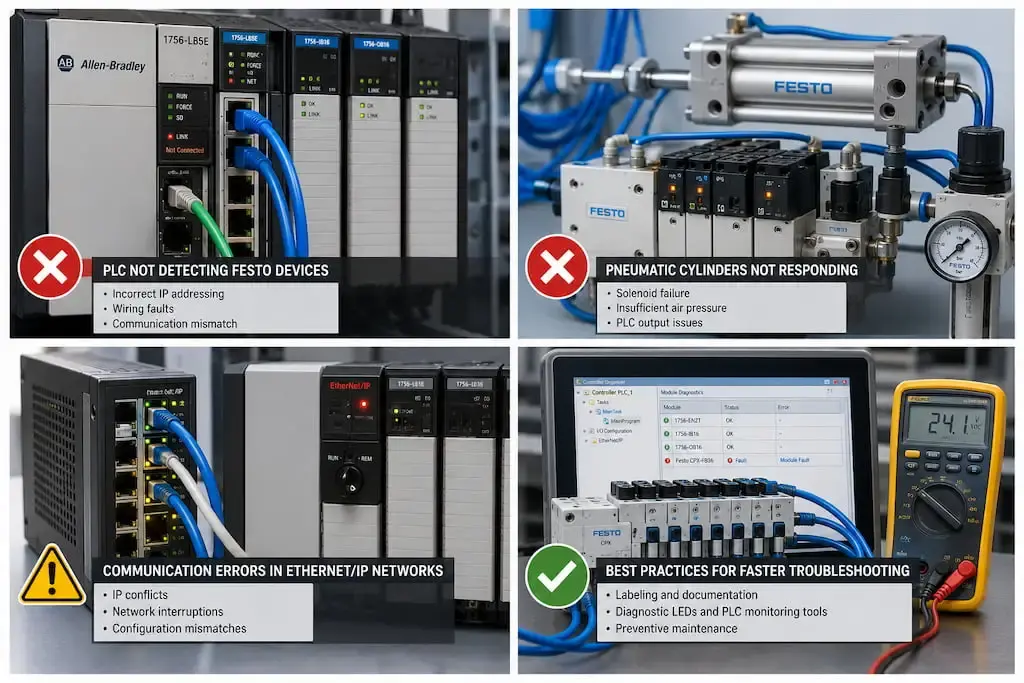
PLC Not Detecting Festo Devices
Common causes include:
- Incorrect IP addressing
- Wiring faults
- Communication protocol mismatches
Always verify device configuration and network settings.
Pneumatic Cylinders Not Responding
Potential issues include:
- Failed solenoid valves
- Low air pressure
- PLC output faults
- Damaged wiring
Systematic testing helps isolate the source of the problem.
Communication Errors in Ethernet/IP Networks
Communication failures often result from:
- IP conflicts
- Network interruptions
- Incorrect device configuration
Many industrial automation communication protocols depend on proper network planning and device configuration.
Best Practices for Faster Troubleshooting
To reduce troubleshooting time:
- Label wiring clearly
- Use diagnostic LEDs
- Monitor PLC status information
- Follow preventive maintenance schedules
Good documentation can significantly reduce downtime.
Best Practices for Reliable Pneumatic PLC Integration
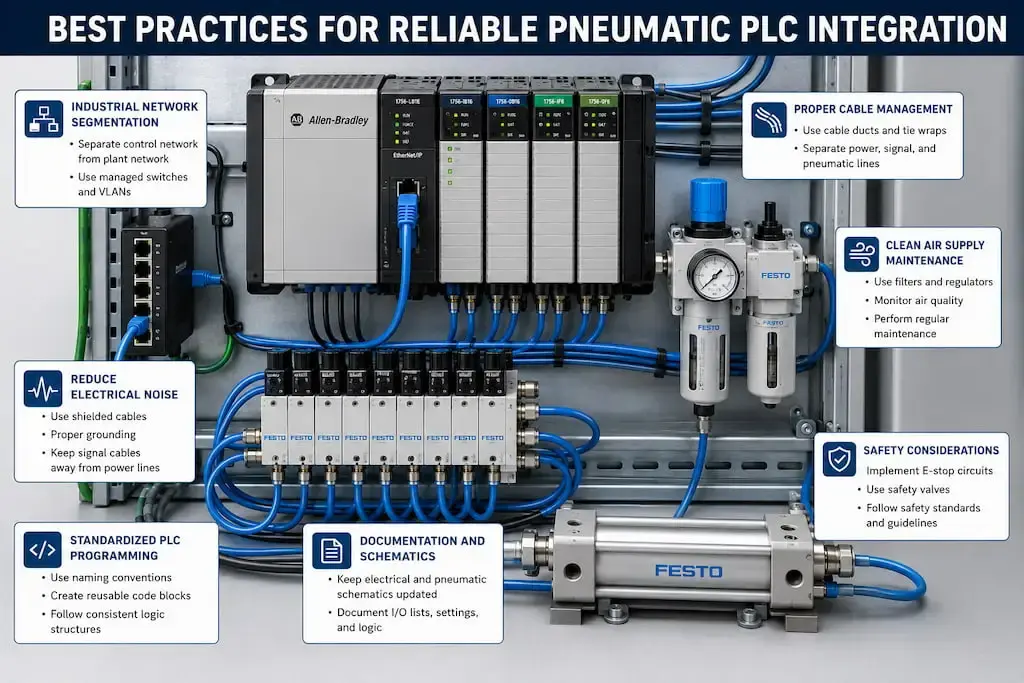
Reliable automation communication systems depend on disciplined engineering practices:
- Proper cable management
- Industrial network segmentation
- Clean air supply maintenance
- Reduced electrical noise
- Standardized PLC programming
- Updated schematics and documentation
Safety Considerations in Pneumatic Automation
Every pneumatic system should include:
- Emergency stop circuits
- Pressure release procedures
- Lockout/tagout processes
- Compliance with machine safety requirements
Safety planning should begin during system design, not after installation.
Industries That Commonly Use Festo and Allen Bradley Integration
Festo and Allen-Bradley integration is common across many industries:
- Packaging
- Food and beverage
- Automotive manufacturing
- Pharmaceutical production
- Material handling
- Assembly automation
These industries rely on pneumatic motion and PLC-based control to maintain productivity and consistent product quality.
Future Trends in Pneumatic and PLC Automation
Industrial automation continues to evolve through:
- Smart pneumatics
- IIoT connectivity
- Predictive maintenance
- IO-Link diagnostics
- Energy-efficient automation systems
As more devices become network-enabled, advanced diagnostics and performance monitoring will become increasingly important.
Why Businesses Choose BSP Automation for Industrial Automation Solutions
BSP Automation supports manufacturers integrating Festo and Allen-Bradley technologies by providing sourcing assistance, technical expertise and access to automation products.
Companies choose BSP Automation because of:
- Support for Festo and Allen-Bradley systems
- Component sourcing assistance
- Industrial automation expertise
- Support for PLCs, sensors, drives, pneumatics and networking equipment
- Solutions for manufacturers and OEMs
As an industrial automation parts supplier, BSP Automation helps customers implement complete industrial automation and control solutions.
Industrial Automation Components Available from BSP Automation
Available product categories include:
- PLC systems
- Pneumatic components
- Sensors
- Industrial networking equipment
- Motor control solutions
- Safety automation products
Customers also gain access to a wide selection of Allen-Bradley parts for both new and existing systems.
Conclusion
Successfully integrating Festo pneumatics with Allen-Bradley PLC systems requires proper planning, reliable communication, correct wiring practices and structured programming. By selecting appropriate components, following established integration procedures and applying proven troubleshooting methods, manufacturers can achieve dependable machine performance and production reliability. Whether implementing a new system or upgrading an existing installation, a well-designed pneumatic PLC architecture provides the foundation for efficient industrial automation.
FAQ
Yes. Many Festo products support Ethernet/IP, digital I/O and other communication methods that allow direct integration with Allen-Bradley PLC platforms.
Ethernet/IP is typically the preferred protocol because it is native to most Allen-Bradley architectures and supports efficient device communication.
Digital outputs are most commonly used to energize solenoid valve coils and control cylinder movement.
Many Festo valve terminals, including CPX-based systems, support Ethernet/IP communication and can be integrated directly into industrial networks.
Start by checking air pressure, valve operation, wiring, PLC diagnostics and network communication settings. Reviewing sensor feedback can also help identify faults quickly.
Packaging, food and beverage, automotive manufacturing, pharmaceuticals, material handling and assembly operations commonly use pneumatic PLC automation.
Yes. BSP Automation supplies Festo pneumatic products, Allen-Bradley PLC hardware, networking equipment, sensors and related automation components for industrial applications.




Have a question?
If you didn't find the automation part you were looking for, our support team is here to help. Just contact us, and we'll do our best to source the exact part you need. We're committed to meeting your needs and ensuring your satisfaction.
Contact Us Now